
Hair Loss Treatment in Huntington Beach, CA
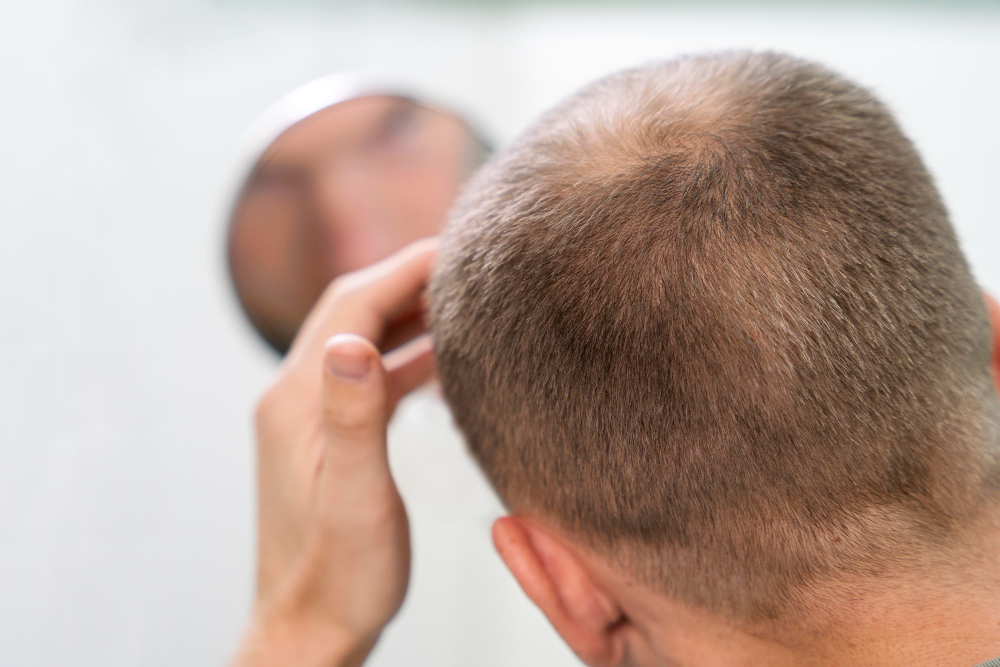
Hair loss can be the result of several underlying conditions, stress, or improper hair care. Many patients schedule an appointment once they notice that their hair is thinning or falling out, but sometimes, hair loss is not obvious.
- First step
- Evaluation to identify the type
- Options
- Topical, oral, PRP, transplant
- PRP course
- 3–6 treatments, one month apart
- PRP full results
- 4–6 months
What are the signs of hair loss?
Signs of hair loss include:
- Receding hairline
- Thinning of the hair on the scalp over time
- Balding that leaves the crown of the head exposed
- Sudden loss of patches of hair
- Loss of hair on the body
What causes hair loss?
Many different things, and they are treated differently. Hair loss can come from a hereditary pattern, from stress or illness some months earlier, from an autoimmune process, from thyroid disease or low iron, from certain medications, from hairstyles that pull on the roots, or from inflammation that scars the follicle. Some types are reversible, some are not, and some are a sign of something going on elsewhere in the body.
That is why the same treatment does not work for everyone, and why a product that helped a friend may do nothing for you.
Do I need an evaluation before treatment?
Yes. The first appointment is an evaluation to work out what type of hair loss you have. That means looking at the scalp and the pattern of loss, going through your history and medications, and in some cases ordering blood work or taking a small scalp biopsy.
Sometimes hair loss is not obvious to the person experiencing it, and the pattern tells us more than the amount does. Getting the diagnosis right is what makes the treatment worth doing.
What are the treatment options for hair loss?
Once we know the type, treatment is matched to it. Options include:
- Topical treatments applied to the scalp
- Oral medications
- Platelet-rich plasma (PRP) injections
- Hair transplantation
Several of these are often used together, and treating an underlying cause — a thyroid problem or an iron deficiency, for example — may be part of the plan. We will go through which of these apply to you at your evaluation.
What is PRP therapy for hair loss?
Here at Z-Dermatology & Skin Wellness Center we use platelet-rich plasma therapy to help with hair restoration. Platelet-rich plasma therapy is a natural approach that draws on your body’s own regenerative powers. In just 20 minutes, this treatment can help address thinning hair and can help restore your confidence.
How does PRP therapy work?
- Your blood is drawn normally, just as it would be done in your PCP’s office.
- The blood is then purified in a centrifuge to extract the plasma.
- The platelet-rich plasma (PRP) is then injected into the areas in need of treatment using microneedles for maximum patient comfort and precision, stimulating your natural regenerative process.
Since the PRP is full of growth proteins, the injection is intended to promote the growth of new, healthy hair. We use needles that are finer in diameter than a human hair, for maximum patient comfort.
How many PRP treatments will I need?
We recommend a course of three to six treatments, spaced one month apart, for the best results. How many you need within that range depends on the type and extent of your hair loss and how your scalp responds along the way.
When will I see results from PRP?
Mild improvement may be noticeable within the first few weeks, and fuller results generally take until the 4-6 month mark. Because hair grows slowly, the fuller picture arrives well after the course of treatments is finished rather than during it.
For more information about platelet-rich-plasma therapy and our hair restoration services, call our office at (714) 951-9119!
We look forward to meeting you.
Send Us a Message
-
Visit Us
18800 Main Street, Suite 111
Huntington Beach, CA 92648 -
Call Us
(714) 951-9119 -
Office Hours
Monday – Thursday 8:00 AM – 5:00 PM Friday 8:00 AM – 4:00 PM Saturday – Sunday Closed